
How Much Does an AI Voice Caller Cost in 2026?
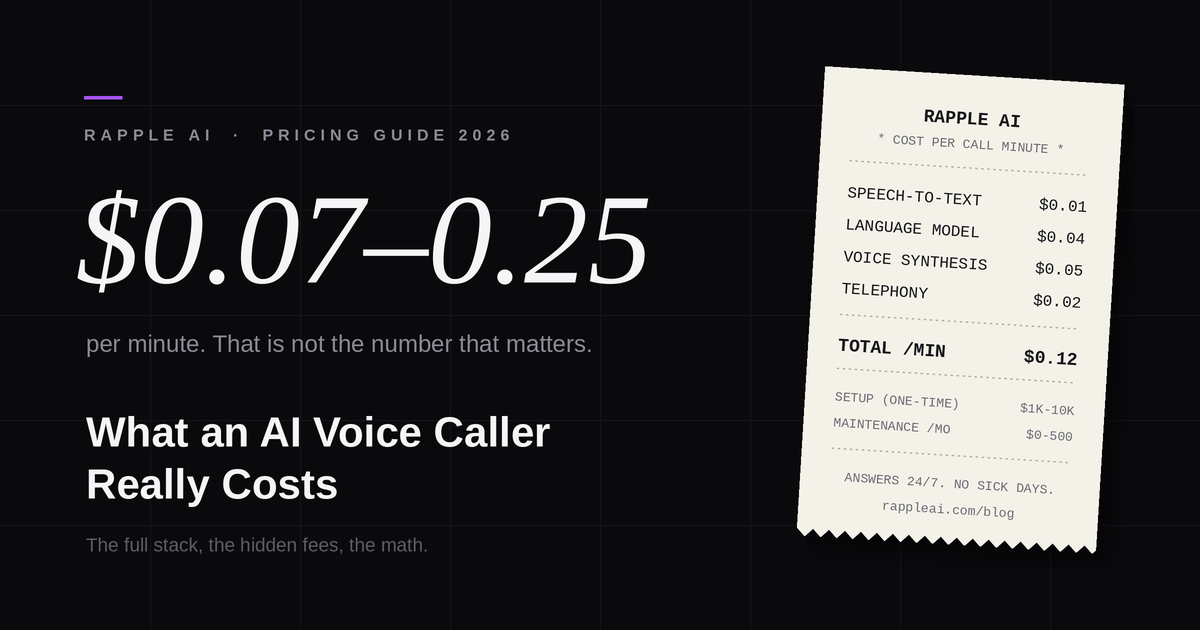
A production AI voice caller in 2026 costs $0.07 to $0.25 per minute to run, $1,000 to $10,000+ to build, and for most service businesses lands at $200 to $600 per month all-in. Those are real deployment numbers, not vendor marketing. The interesting part is what sits inside them, because that is where buyers overpay.
The per-minute cost stack, component by component
Every AI phone call is four metered services stacked on top of each other. Here is what each one costs at 2026 market rates:
| Component | What it does | Typical cost/min |
|---|---|---|
| Speech-to-text | Transcribes the caller in real time | $0.005 - $0.01 |
| Language model | Decides what to say next | $0.02 - $0.07 |
| Voice synthesis | Speaks the reply | $0.02 - $0.07 |
| Telephony | The actual phone line | $0.01 - $0.02 |
Stack those and you get a raw cost around $0.06 to $0.17 per minute. Platforms like Vapi, Retell AI, and Bland add orchestration and margin on top, which is how you arrive at the $0.07 to $0.25 quoted range.
Two levers move you inside that range:
- Model choice. A frontier model reasons better on messy calls but can cost 3x more per minute than a fast mid-tier model. Most receptionist use cases do not need frontier reasoning; a well-prompted mid-tier model handles them at the bottom of the range.
- Voice quality. Premium cloned voices sound indistinguishable from human and cost 2 to 3x more than standard voices. For outbound sales this is worth it. For appointment confirmations it usually is not.
A worked example with real math
Take an HVAC company running Google ads. It gets 25 inbound calls a day, average 4 minutes, and misses about a third of them after hours or during jobs.
- Minutes handled by AI: 25 calls x 4 min x 30 days = 3,000 min/month
- Usage at $0.12/min: $360/month
- Two local phone numbers: $4/month
- Maintenance retainer: $250/month
- Total running cost: ~$614/month
Now the other side of the ledger. If the AI recovers just the missed third, that is roughly 250 calls a month that previously rang out. At a 20% booking rate and a $450 average ticket, recovered revenue is $22,500/month. The system pays for itself off the first two recovered jobs.
Run this math for your own business before you look at any vendor pricing page. If the recovered-revenue number is small, an AI caller is the wrong purchase regardless of cost.
Setup pricing: the three real tiers
Usage is the cheap part. The build is where quotes vary wildly, so here is what each tier actually contains:
Tier 1: Inbound receptionist ($1,000 - $2,500)
Answers every call, handles FAQs, captures name, number, and job details, texts you a summary. One conversation flow, no integrations beyond SMS. A competent builder ships this in under two weeks.
Tier 2: Speed-to-lead outbound agent ($3,000 - $6,000)
Fires within 60 seconds of a form submission, qualifies against your criteria, books directly into your closer’s calendar with live availability checks, retries no-answers on a schedule, and falls back to SMS. This is the tier with the highest ROI for anyone spending on ads, because lead contact rates decay by roughly 8x between minute one and minute thirty.
Tier 3: Full pipeline system ($6,000 - $10,000+)
Everything above, plus CRM integration in both directions (every call logged with transcript, outcome, and recording; agent reads deal context before dialing), multi-stage follow-up sequences for cold leads, and reporting dashboards. This is no longer a phone agent, it is a revenue operations layer.
The costs nobody puts on the pricing page
- Prompt maintenance. Offers change, edge cases surface, models get updated. Budget $150 to $500/month for transcript review and tuning, or accept slow degradation.
- Compliance for outbound. In the US, TCPA rules require consent for automated outbound calls, and penalties run $500 to $1,500 per violation. A proper build includes consent capture and DNC list checks. If a vendor never mentions this, walk away.
- Concurrency limits. Cheap plans often cap simultaneous calls. If your ads spike, calls queue or drop. Confirm concurrency before you sign anything.
- Integration seats. CRM API access sometimes requires a higher plan tier of the CRM itself. Check before the build starts, not after. One way around this entirely: run a free self-hosted CRM with n8n, where the API is yours with no plan gates.
DIY platform vs. hiring a builder
You can sign up for Vapi or Retell today and have a demo agent in an hour. The honest comparison:
| DIY on a platform | Agency build | |
|---|---|---|
| Upfront cost | $0 - $500 | $1,000 - $10,000+ |
| Time to production quality | 40 - 100+ hours of your time | 1 - 4 weeks of theirs |
| Handles edge cases | Only the ones you find | The ones they have hit across many deployments |
| Compliance and failure handling | On you | Built in, contractually |
The demo is easy. The last 20%, interruption handling, background noise, callers who ramble, calendar edge cases, is where in-house builds stall. If your time bills at $100+/hour, the agency route is usually cheaper in real terms.
How to keep the cost down
- Route simple intents (hours, address, confirmations) to a cheaper model and reserve the expensive one for qualification calls.
- Keep system prompts tight; bloated prompts cost money on every single turn of every call.
- Buy usage in committed volume once you pass ~2,000 min/month; most platforms discount 20 to 40%.
- Do not pay for a premium voice on calls where the caller just wants a booking confirmed.
The bottom line
Price the outcome, not the minutes. Start from your missed-call and slow-follow-up math, pick the smallest tier that fixes it, and treat per-minute cost as a rounding error next to recovered revenue.
We build these systems at Rapple AI. If you want your own numbers mapped out, call volume to real monthly cost to expected recovered revenue, book a short call and we will run the math with you.
Frequently asked questions
How much does an AI voice caller cost per month?
For a service business handling 500 to 2,000 call minutes a month, expect $60 to $400 in usage, $5 to $30 in telephony and phone numbers, and $0 to $500 for maintenance. Setup is separate: $1,000 to $2,500 for a basic inbound receptionist, $6,000 to $10,000+ for a full outbound system wired into your CRM.
What does the per-minute price actually include?
Four components: speech-to-text (about $0.01/min), the language model (about $0.02 to $0.07/min depending on the model), voice synthesis (about $0.02 to $0.07/min depending on voice quality), and telephony (about $0.01 to $0.02/min). Platforms bundle these into roughly $0.07 to $0.25 per minute all-in.
Is an AI voice caller cheaper than a human receptionist?
At typical volumes, yes, by roughly 10x. A receptionist costs $2,500 to $4,000+ per month for 40 hours a week. An AI agent covering the same calls typically runs $200 to $600 per month and answers 24/7. The gap widens if you count missed-call revenue.
What makes the price go up the most?
Complexity, not volume. Multi-step qualification logic, live calendar booking, CRM writes, and outbound compliance work all add build hours. Usage cost scales linearly and stays predictable; scope creep in the conversation design is what blows budgets.
Want this built for your business?
Rapple AI builds AI voice callers, n8n automations, and B2B lead-gen systems for service businesses.
Book a call →